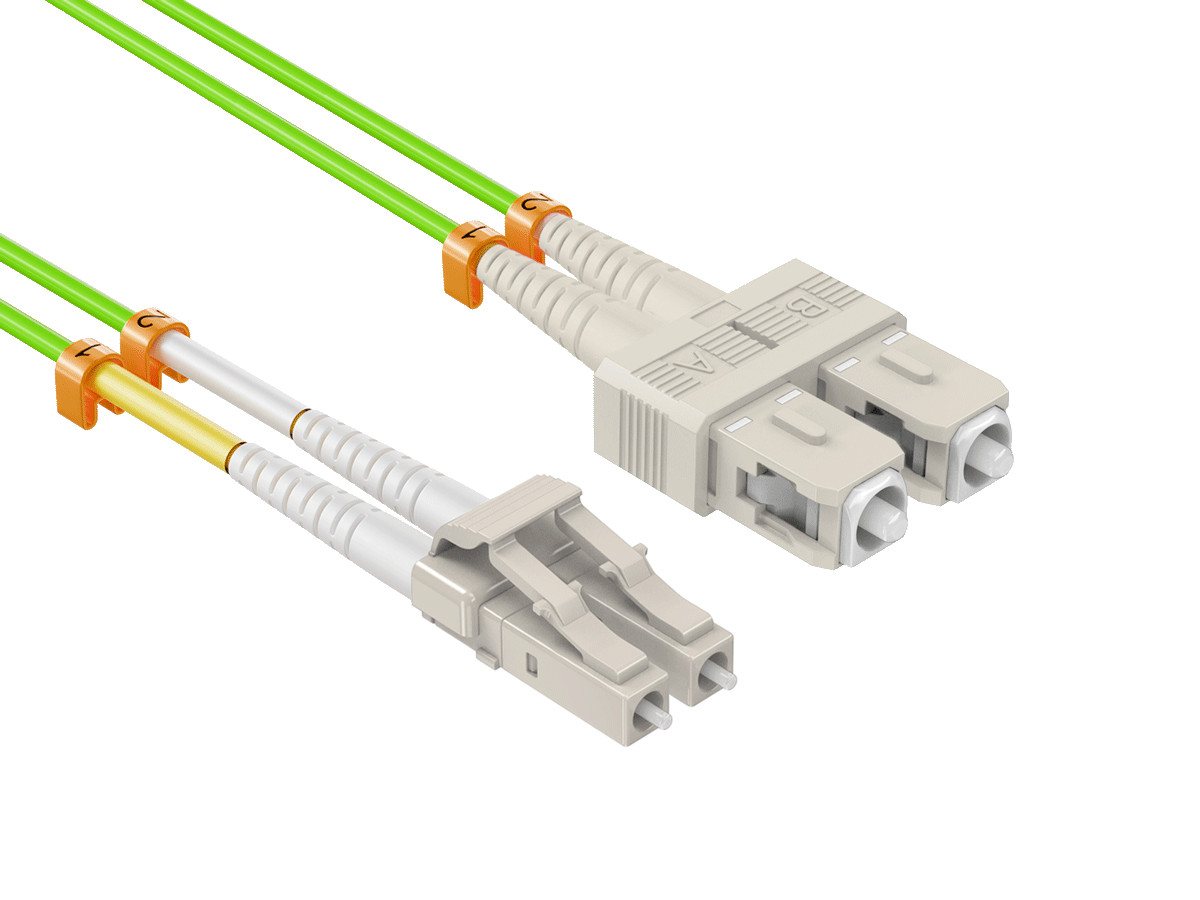
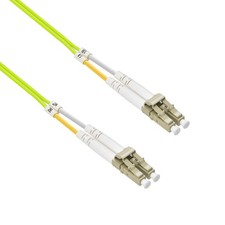
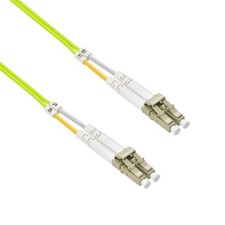
7m OM5 LC to SC Multimode Fiber Patch Cable, Wideband 50/125 Duplex Corning, LSZH/OFNR, Lime Green
The CableLeader FB137-42XX is an OM5 wideband multimode duplex patch cable with LC/UPC connectors on one end and SC/UPC on the other. OM5 keeps the familiar 50/125 um core geometry of OM4 but is characterized across a wider spectral window, the property shortwave wavelength division multiplexing (SWDM) transceivers use to carry multiple wavelengths on a single fiber pair. The lime green jacket is the standardized OM5 identification color, and the mixed LC-to-SC termination lets one cable bridge an LC switch port to legacy SC panels or media converters without an adapter chain.
The LC end uses short boot connectors — a 19.5 mm boot, shorter than a standard LC boot — that reclaim rear clearance behind densely packed switch faceplates and 1U SFP cages. LC is the small-form-factor format on current switches, SFP optics, and high-density panels. Each LC/UPC ferrule is polished to UPC grade and factory tested to 0.30 dB maximum insertion loss.
The SC end carries the square-bodied SC/UPC push-pull format still standard on older multimode patch panels, media converters, and building-entrance frames. Its 2.5 mm ferrule seats with a positive click and holds under vibration, keeping SC common in AV distribution and industrial cabinets. Both connectors are independently rated, so the assembly performs identically to an LC-LC or SC-SC cable of the same grade — 0.30 dB max insertion loss and 35 dB min return loss per end at 850/1300 nm.
The jacket is LSZH/OFNR rated under UL file E510298. Low-smoke zero-halogen material limits toxic emissions in enclosed equipment rooms, and the OFNR riser rating permits vertical runs between floors. The Corning ClearCurve OM5 fiber inside is bend-optimized, tolerating tight routing radii in cable managers and vertical rings without the attenuation penalty older multimode glass shows.
Backward compatibility is the practical headline: the 50/125 core matches OM4 and OM3, so this cable plugs into any installed multimode equipment and performs at the level of the link it joins. Deployments concentrate where an LC-port switch meets an SC-port panel or converter: data center migrations, machine-room refreshes on wideband cabling, and AV setups bridging SC instruments to LC test sets. Lime green patching signals OM5 runs at a glance.
Compatibility & Ordering Information — FB137-42XX mates with any standards-compliant LC/UPC and SC/UPC multimode ports, including 850 nm SFP, SFP+, and QSFP breakout optics on Cisco, Ubiquiti, MikroTik, Juniper, and HPE platforms, plus SC media converters and LC adapter panels. The family is offered from 1 m through 30 m; select the variant matching the switch-to-panel distance plus a service loop. For LC-to-LC OM5 links see the FB136-41XX family; for SC-to-SC OM5 links see the FB138-46XX family; aqua OM4 versions are listed separately in the CableLeader fiber optic cables catalog.
Product Comparison: LC-SC vs LC-LC OM5 Multimode Patch Cable
Both cables use identical Corning OM5 50/125 ClearCurve fiber and UPC polish; the difference is the connector on each end and the equipment each links. The table summarizes the decision:
AttributeLC-SC OM5 (this product)LC-LC OM5Connector EndsLC/UPC (short boot) on one end, SC/UPC on the otherLC/UPC on both endsBridgesLC switch/SFP ports to SC panels, media converters, AV framesLC-to-LC links between switches, SFP optics, and LC panelsFiberCorning OM5 50/125 wideband ClearCurveCorning OM5 50/125 wideband ClearCurve (same grade)Optical Performance0.30 dB max IL, 35 dB min RL per connectorIdentical rating; connector format does not affect lossBest ForMixed plants where LC gear meets SC-terminated infrastructureUniform LC environments and high-density LC patching
Select the LC-SC version when one device is LC and the other is SC.
Select the LC-LC version (FB136 family) when both ends of the link are LC.
FAQ
What is the difference between an LC-SC and an LC-LC OM5 cable?
An LC-SC cable has an LC connector on one end and an SC connector on the other, while an LC-LC cable is LC on both ends. Both use the same OM5 50/125 wideband fiber and perform identically — 0.30 dB max insertion loss per connector. Choose LC-SC when one device is LC and the other is SC; choose LC-LC when both ports are LC.
Is this OM5 cable compatible with my existing OM4 or OM3 equipment?
Yes. OM5 uses the same 50/125 um core geometry as OM4 and OM3, so it mates with any multimode SFP, SFP+, or QSFP optic and any LC or SC multimode panel with no adapters. The link runs at the grade of its weakest element, exactly as an OM4 cable would in the same position.
What do OM5 and 50/125 mean on a fiber patch cable?
50/125 describes the glass geometry — a 50 um multimode core inside a 125 um cladding. OM5 is wideband multimode fiber: the same core as OM4 but characterized across a wider wavelength band for shortwave wavelength division multiplexing (SWDM). On conventional 850 nm links OM5 and OM4 perform equivalently.
Which end plugs into my switch and which into the panel?
The LC end — the smaller latched connectors — plugs into switch ports, SFP/SFP+ transceivers, and modern LC panels. The SC end — the larger square push-pull connectors — plugs into SC-terminated panels, media converters, and AV frames. Route the short boot LC end into the denser side, where ports sit closest together.
Should I choose OM5 or OM4 for a new multimode installation?
Choose OM5 when the installation should be ready for wideband SWDM optics or when you want one future-oriented multimode grade across a new build; the cost delta over OM4 is small at patch-cable scale. Choose OM4 (FB105 aqua family) when matching an installed OM4 plant with no wideband plans — 850 nm performance is equivalent.