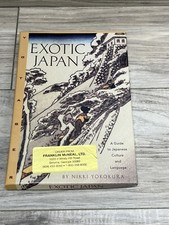
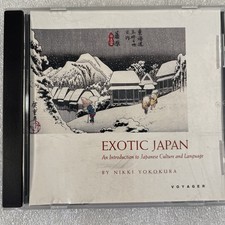
Exotic Japan byNoriko (Nikki) Yokokura(CD-ROM Interactive) A Guide to Japanese Culture & Language SealedSealed Collectible CD-Rom Rare OOP from original Voyager Production Release
Multi Media CD-Rom Software
Produced in the Mid-1990s by the Original Voyager Company
One of the best developers of multimedia CD-ROMs that ever existed, Voyager Company, released dozens of high-quality educational CD-ROMs between 1993 and 2000 before being bought out by Learn Technologies, which then quietly went out of business sometime in 2002. This is one of their interactive CD-Roms for PC/Windows or style="">A wonderful blend of the personal and the encyclopedic, EXOTIC JAPAN provides business-people, travelers, and students alike with the skills to operate successfully and independently in this fascinating country. About the author: Born and raised in Japan, Noriko (Nikki) Yokokura received her university undergraduate and post-graduate education in North America. She has taught Japanese at both the University of Toronto and at McMaster University in Canada, using an innovative multi-media-based curriculum.
Journey through the exotic land ofJapan and discover customs, culture, and language. Native speakers guide youthrough proper pronunciation as you record and replay your own voice.Discover intriguing facts about thebullet train and the protocol of business cards. Play traditional japanesegames and learn how to use chopsticks.
Why struggle with conjugationswhen you can take an intimate tour of modern Japan along the ancient TokaidoRoad--and learn key signs and phrases along the way? Choose your own paththrough more than 150 lessons and quizzes on topics ranging from the bullettrain to Japanese table manners. Underlined words are pronounced aloud, andmale or female native speakers (your choice) guide you step by step as yourecord and replay your own voice.Useful kanji characters come to life in ingenious animations, whilenineteenth-century woodcuts, musical passages, and a traditional snakes andladders" game delight the eye and ear.
Technical requirements for Voyager's CD-Roms:
Windows: 486SX-33 or higher processor; 640 x 480, 256 color display; 8 MB RAM MPC2-compatible CD-ROM drive and sound card with speakers or headphones; Microsoft Windows 3.1 (TM); MS-DOS 5.0 or higher.
Macintosh: Any Macintosh (25-MHz 68030 processor or better); System 7 or higher; 5,000K of available RAM; 13" color monitor; double-speed CD-ROM drive.
The Voyager collection of CD-ROMs represents an era that is fading into oblivion.Due to a lack of computer systems still capable of executing this software, Voyager products that are still available in the original sealed packaging have significant historical value for collectors only.
The following discussion of CD-ROM technology and its preservation is found inThe International Journal of Digital Curation;Volume 7, Issue 2 | 2012:
Virtual CD-ROM Collections
Although the Voyager CD-ROMs have substantial historical significance, they, and most other published CD-ROMs, are destined to have a dwindling user base whose expertise in the systems required to use them is in sharp decline. The physical machines required to execute them have already disappeared from most educational institutions and even the operating systems are increasingly hard to find; at Indiana University, which once had many hundreds of ?classic macs?, only one person within our University IT Services had distribution disks of the corresponding operating system software. The physical copies of these CD-ROMs are disappearing from library shelves. In seeking examples for this paper we made extensive use of interlibrary loan and we found that many cataloged copies of Voyager CD-ROMs are either missing or damaged.
The long-term probability for individual libraries providing physical access to the Voyager and other published CD-ROMs is nearly nil. The user base is dwindling, the existing hardware and softwaresupport disappearing, and the physical media degrading. While we believe these materials have substantial historical significance, their ultimate survival depends upon spreading the preservation burden across many institutions through a virtual collection that enables networked access for a sparsely distributed base of patrons using modern work-stations.